A Prompt for the Agent Overnight, and a Strategy Game
I was travelling, and the only machine with me was a MacBook Air M4 with 24 GB of memory. Alibaba had released Qwen 3.8 27B the day before. I was on edge about it all day; in the evening, finally, some free time. So I downloaded a low quantisation (3 bit) and landed at around two tokens per second. Useless for chat or live vibe coding, but good enough for one attempt in the pi harness:
"Can you create a html / js / css based space based strategy game?"
I just left it running.
It went all night and a good part of the next day. What came out was a playable turn-based sector strategy game: a star map with systems you own and systems you do not, minerals, energy and population as the economy, four ship classes with different costs and ranges, a research tree. It looked like something I would have loved to play as a teenager.
The part I keep thinking about
The model did not stop at building the game. It wrote a simulation to play the game to the end (one side controlled by an AI, the other playing the way a human would) and then worked out how easy it is to beat.
It did not wait for me to discover the balance problems. It found them, on its own, at three in the morning, on a laptop.
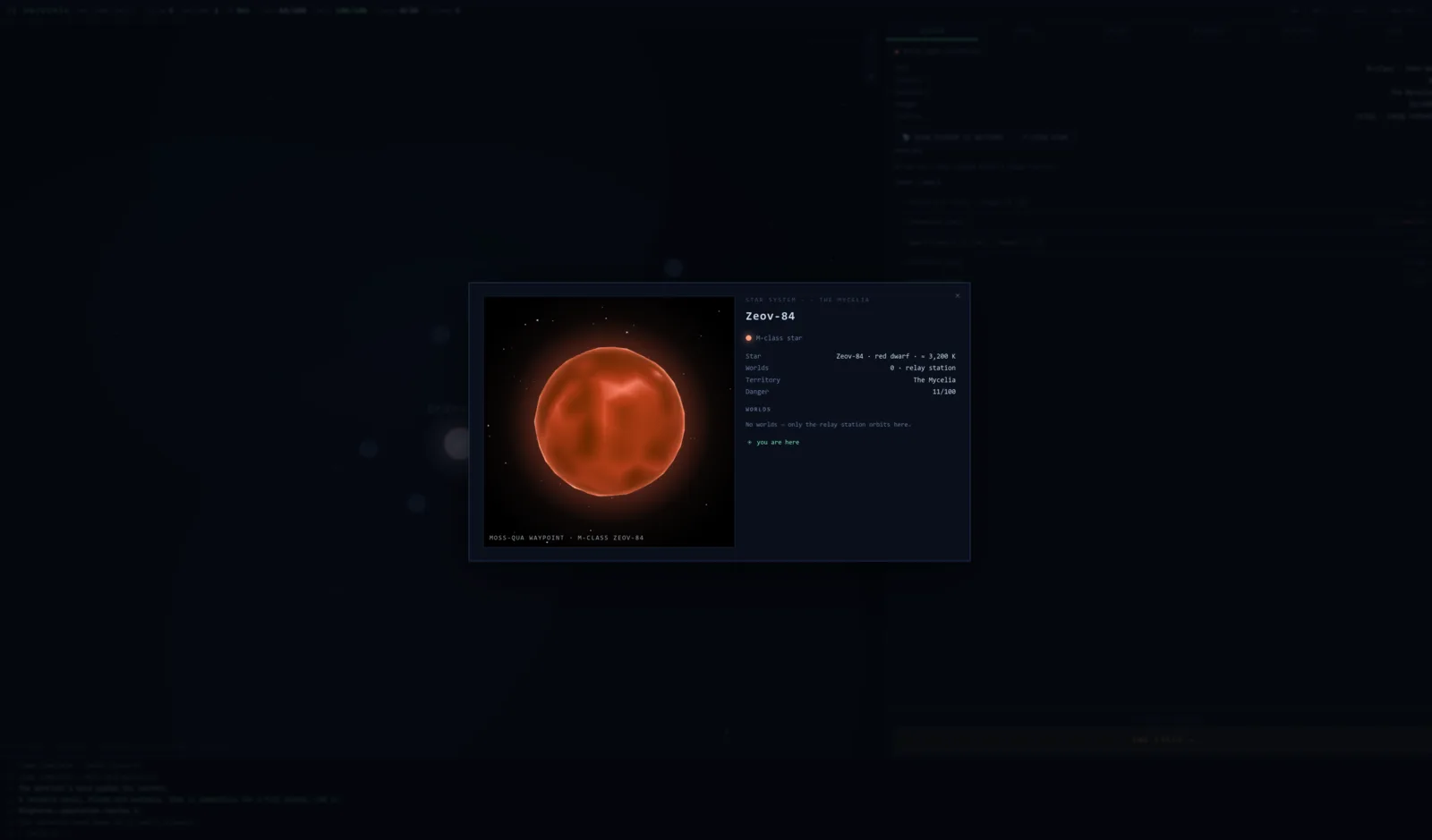
A second experiment, back home on the basement machine, where the same model runs much more comfortably: I handed it a simple planet generator I wrote seven years ago. Again one simple prompt. What came back was a strategy game with a procedurally generated universe, narrative snapshots between turns, distinct characters, and trading and RPG mechanics in the game loop. I prompted twice more to iron out small issues. The result is TS UNIVERSE — The Long Drift.
The catch
On small hardware: thinking in Qwen 3.8 27B takes forever. A one-shot prompt answers in hours, even when the prompt and the task are small. That makes the model on too weak a machine useless for anything interactive: I will not sit and watch it deliberate while I decide what to type next.
For batch processing it is nevertheless very useful.
Takeaways
We judge models on benchmarks and on chat, which rewards fast and agreeable answers. But what I measured was how much self-contained, testable work a model can carry on its own before it needs me. The answer a few months ago would have been "very little", and today it is "a whole game".
In batch, overnight, it can deliver useful results even on hardware that is arguably too weak. In chat you need something stronger. But it is not just the model — the harness plays a part, too; here it was Pi. In the agentic loop it produced a better result than classic development environments plus AI chat would have.